The Narrator Is Sent to the Missing Children's Center
The Painted BirdThe Narrator Is Sent to the Missing Children's Center marks a painful change of custody at the end of the war: the boy leaves the regiment that has become his home and enters an institution tasked with finding out whether he still has family. The transfer is presented as an administrative necessity, but its emotional force lies in the attachments and hopes it interrupts. He is sent toward his prewar city carrying gifts, books, and the uniform that makes him feel like a soldier, while the adults around him try to prepare him for an uncertain wait.
The order to leave
Red Army mentor Gavrila tells the boy that the war is ending, that the country has been liberated from the Germans, and that regulations require lost children to be taken to special centers until their parents’ survival can be established. The explanation makes the transfer part of a broader postwar system rather than a decision directed at the boy alone. Yet the rules turn his immediate future over to an institution and remove him from the people among whom he has learned to live.
The boy needs several days to accept that he will leave Gavrila, Red Army sniper Mitka, and his other friends in the regiment. Gavrila is firm, but not indifferent: the boy knows that Gavrila and Mitka have discussed what should happen to him and would have chosen another solution if one had been available. Their concern does not cancel the separation; it makes clear that it has been considered and that, under the circumstances, they see no alternative.
Gavrila offers a conditional promise that gives the boy a future to hold on to. If no relatives claim him within three months after the war ends, Gavrila will take care of him and send him to a school where he can be taught to speak again. The promise recognizes both the possibility of family recovery and the boy’s continuing inability to speak. For now, however, care is deferred: first he must go to the center and wait to learn whether anyone will come for him.
The parting and the journey
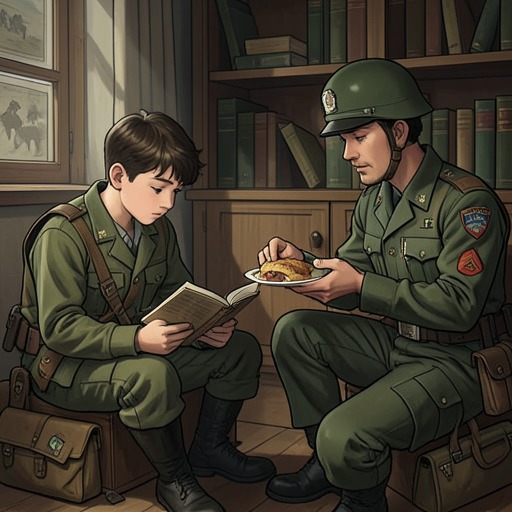
Before the departure, soldiers give the boy a bag of presents, and Gavrila and Mitka give him books. A regimental tailor has made him a Soviet Uniform, and in one pocket he finds a small wooden pistol bearing Stalin’s image on one side and Lenin’s on the other. These objects make the farewell tangible. They also send him away with signs of the life he is leaving, rather than with the ordinary belongings of a child being placed in care.
Sergeant Yury is to accompany him to the town where the lost-children center is located. It is the country’s largest industrial city and, more personally, the place where the boy lived before the war. Gavrila checks that he has all his things and that his personal file is in order. It records the information the boy has given about his name, former home, parents, relatives, friends, and hometown: a family history reconstructed from what he can remember, assembled for officials who may be able to trace the people he has lost.
At the final farewell, Mitka pats the boy on the shoulder and urges him to uphold the Red Army’s honor. Gavrila embraces him warmly, and the other soldiers shake his hand as if he were grown. The boy wants to cry but keeps his face composed like a soldier’s boot laced tight. The effort to hold himself together shows how thoroughly the regiment’s expectations have become part of his way of facing separation, even as the people who taught him that discipline are the ones he must now leave.
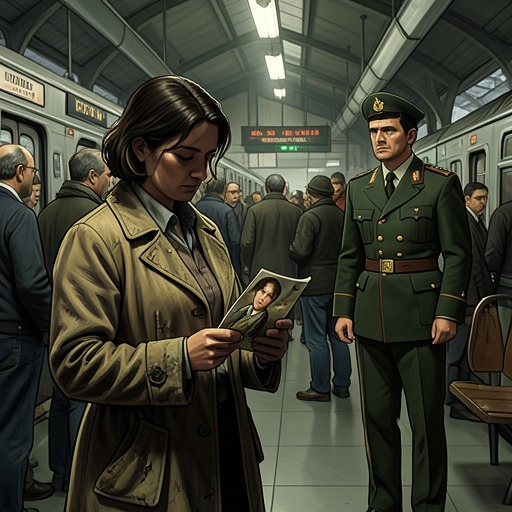
The train takes two days to reach its destination. Its repeated stops at damaged signals and between stations expose the boy to a country still marked by war: bombed towns, deserted villages, abandoned military vehicles and aircraft, and ragged people asking passengers for cigarettes and food. Half-naked children stare at the passing train. At stations, crowds include soldiers, former prisoners, invalids, civilians, and blind people; nurses guide emaciated survivors in striped concentration-camp clothing. The journey therefore carries him through both the machinery of postwar transport and the visible human aftermath of the conflict.
Arrival at the children’s home
A military driver takes Yury and the boy from the station to the orphans’ home, which occupies several old houses on a side street. Children peer out of its many windows. The crowded city and the institutional building contrast with the regiment’s familiar circle of comrades: the boy has arrived at a place intended to receive children like him, but not one already shaped around his particular attachments.
Yury and the boy wait for an hour in the lobby. While Yury reads a newspaper, the boy pretends not to care. When the woman principal comes over, she takes the folder from Yury, signs papers, and places a hand on the boy’s shoulder. He firmly shakes it off. In his understanding, the epaulets on a uniform are not meant for a woman’s hands. The gesture is a small refusal of the new institution’s authority over him, expressed through the military identity he still claims.
The next farewell is between the boy and Yury. Yury acts cheerfully, jokes, straightens the boy’s forage cap, and tightens the string around the books inscribed by Mitka and Gavrila. They embrace like two men, with the principal standing nearby. At that moment the boy clutches the red star on his left breast pocket, a gift from Gavrila bearing Lenin’s profile. He believes the star that guides workers toward their goal might also bring him good luck, then follows the principal into the home.
The first signs of institutional life are not welcoming to him. Lessons are under way behind open classroom doors; children scuffle and shout in the corridors. Some boys point at his uniform and laugh, and someone throws an apple core that hits the principal after the boy ducks. The scene places him among other children without making him feel that he belongs among them. The uniform distinguishes him, but it also exposes him to ridicule.
What the transfer leaves unresolved
In the first days, the principal wants him to exchange the uniform for ordinary civilian clothes sent by the International Red Cross. He nearly strikes a nurse when she tries to take the uniform and instead keeps his tunic and trousers folded beneath his mattress. His resistance continues the struggle begun when he shook off the principal’s hand: the transfer has changed who is responsible for him, but it has not persuaded him to relinquish the identity attached to his military clothes.
The event ends with arrival, not with the answer the boy needs. His file gathers the fragments of information he remembers, and the center is meant to determine whether his parents are still alive, but no reunion occurs in this episode. Gavrila’s three-month promise offers a possible fallback, while the boy’s faith in the red star supplies a more immediate hope. Neither can remove the uncertainty that separates the regiment he loves from the family and future he cannot yet recover.
The narrative also sets this bureaucratic passage against the destruction that preceded it. Earlier, the boy’s world included deportation trains carrying Jews and Roma, villagers watching them pass, and traces of people left along the railway. By the time he travels toward the children’s home, the war is said to be ending, yet the train journey still passes through ruined places and among survivors returning from camps. The transfer thus changes the boy’s location and guardianship without presenting postwar life as a clean break from violence or loss.